
Bank DNS bank.in Domain
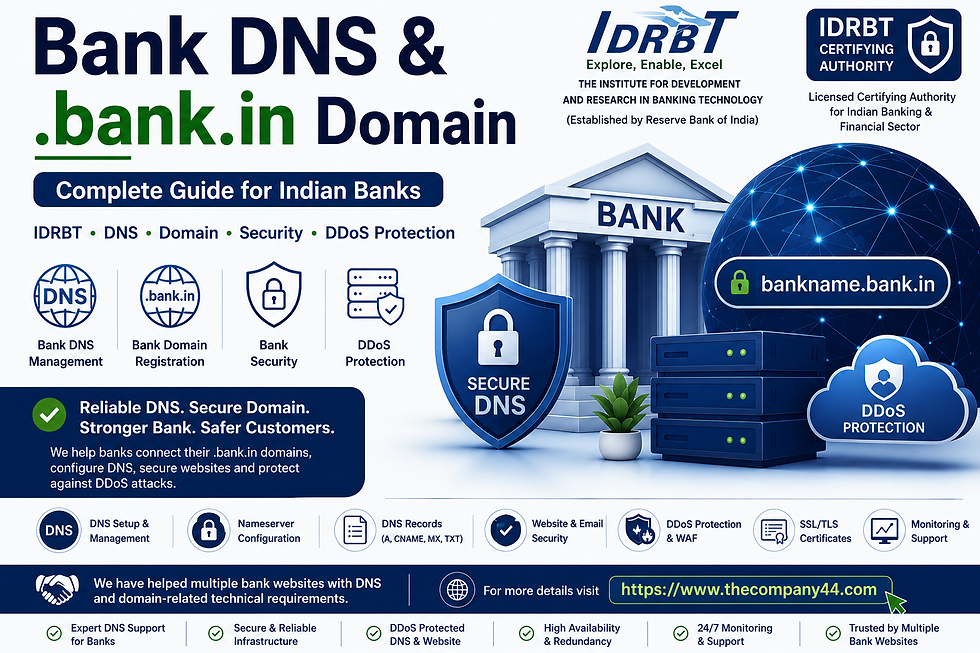
Bank DNS, .bank.in Domain & IDRBT: Complete Guide to Secure Banking Websites, Domain Security & DDoS Protection
A Complete Guide for Indian Banks, Cooperative Banks and Banking Technology Teams
In the modern banking environment, a bank's website is more than a simple online presence. It is an important digital identity through which customers access information, online banking services, contact details, branch information, alerts, digital services and other financial resources.
For a bank, therefore, domain name security, DNS security, website security, DDoS protection and reliable DNS infrastructure are extremely important.
With the introduction and operationalisation of the .bank.in domain for banks in India, banks now have a dedicated domain namespace designed to strengthen trust and help combat fraud in digital banking.
A typical bank domain can follow the format:
bankname.bank.in
For example, a bank may have a domain structured around its approved bank name under the .bank.in namespace.
The Institute for Development and Research in Banking Technology (IDRBT), established by the Reserve Bank of India, has been authorised to function as the exclusive registrar for .bank.in and .fin.in domains. RBI's April 22, 2025 circular instructed banks to commence migration to the .bank.in domain and stated that the migration was to be completed by October 31, 2025.
At The Company 44, we help banks with the technical side of bank domain connectivity, DNS configuration, nameserver setup, DNS records, website connection, DNS security and related infrastructure.
We have helped multiple bank websites with DNS and domain-related technical requirements.
What Is DNS?
DNS stands for Domain Name System.
DNS is one of the fundamental technologies that makes the Internet work.
When a customer types a domain such as:
bankname.bank.in
into a browser, the browser needs to determine which server or service should handle that request.
DNS performs this translation.
In simple terms:
Domain Name → DNS → IP Address / Service → Website
Without DNS, users would have to remember IP addresses instead of easy-to-use domain names.
For a banking website, DNS can connect the bank's approved domain with its website hosting platform, web server, email infrastructure, security services and other Internet-facing services.
Why DNS Is Important for a Bank
DNS may appear to be a small technical component, but it is a critical part of a bank's Internet infrastructure.
A DNS failure can potentially result in:
Website not opening
Email delivery problems
SSL certificate issues
Authentication or verification failures
Third-party service failures
Website downtime
Difficulty accessing banking information
Incorrect routing
Increased exposure to DNS-based attacks
For this reason, bank DNS management should be treated as part of the bank's overall cybersecurity and infrastructure strategy.
A properly designed DNS architecture should consider:
DNS availability
DNS redundancy
Authoritative nameservers
DNSSEC where applicable
DDoS protection
Access control
Monitoring
Logging
Backup DNS configuration
Change management
Disaster recovery
Domain security
SSL/TLS configuration
Email DNS security
What Is a .bank.in Domain?
The .bank.in domain is a dedicated Internet domain namespace for eligible banks in India.
RBI introduced the initiative to strengthen cybersecurity and enhance public confidence in digital banking and payment systems. RBI subsequently operationalised the .bank.in domain through IDRBT, which was authorised by NIXI as the exclusive registrar for the domain.
The important concept is that a bank's Internet identity can be represented using a dedicated banking namespace:
bankname.bank.in
instead of relying only on a conventional generic domain.
The IDRBT domain registration handbook explains that IDRBT was authorised as the exclusive and accredited registrar for .bank.in and .fin.in domains for eligible RBI-regulated entities.
Why Bankname.bank.in Is Important
A dedicated banking domain provides a recognisable digital identity for an eligible bank.
For customers, seeing a domain ending in:
.bank.in
can provide an additional signal that the website belongs to the banking domain namespace.
However, it is important to understand that a .bank.in domain by itself does not replace complete website cybersecurity.
A secure bank website still requires appropriate:
Web application security
SSL/TLS
DNS security
DDoS protection
Server security
Vulnerability management
Access controls
Monitoring
Email security
Security policies
Incident response
The domain is one important layer of the security architecture—not the entire security architecture.
IDRBT and .bank.in Domain Registration
The Institute for Development and Research in Banking Technology (IDRBT) was established by the Reserve Bank of India and works extensively in banking technology, cybersecurity and financial-sector technology.
IDRBT's current domain registrar information states that it is the exclusive registrar for .bank.in and .fin.in domains for eligible entities regulated and licensed by RBI.
RBI's circular on migration to .bank.in specifically directed banks to initiate the migration process and contact IDRBT for registration and migration guidance.
The IDRBT domain registration portal provides the registration process and prerequisites for eligible entities.
IDRBT Certifying Authority
IDRBT also has an important role in the Indian banking and financial technology ecosystem as a Certifying Authority (CA).
IDRBT states that it is the Certifying Authority for the Indian Banking and Financial Sector and is licensed by the Controller of Certifying Authorities, Government of India, for issuing Digital Certificates.
The IDRBT CA provides digital certificates used by banks and financial institutions for systems and authorised officials participating in financial networks and payment systems.
These certificates support security properties including:
Authentication
Data integrity
Confidentiality
Verification
Non-repudiation
Secure electronic communication
IDRBT's CA infrastructure also includes certificate lifecycle management capabilities such as Certificate Revocation Lists, Online Certificate Status Protocol and timestamping services.
Important distinction
It is useful to distinguish between:
IDRBT Domain Registrar
and
IDRBT Certifying Authority
The Domain Registrar function relates to registration of eligible .bank.in and .fin.in domain names.
The Certifying Authority function relates to digital certificates and Public Key Infrastructure (PKI).
Both are important components of the broader banking technology and cybersecurity ecosystem, but they serve different technical purposes.
What Is Bank DNS?
Bank DNS refers to the DNS infrastructure used to resolve and manage a bank's Internet domains and related services.
For a bank using a domain such as:
bankname.bank.in
DNS may be responsible for connecting the domain to:
Bank website
Website hosting platform
Web servers
Email servers
Email security systems
Security/CDN services
API endpoints
Verification services
Other approved Internet-facing services
What Are Authoritative DNS Servers?
Authoritative DNS servers contain the DNS information for a domain.
When a recursive resolver needs authoritative information about a domain, it ultimately queries the authoritative DNS infrastructure responsible for that domain.
For a bank, authoritative DNS availability is extremely important.
If the authoritative DNS infrastructure becomes unavailable, customers may experience problems resolving the bank's domain even if the bank's actual website server is operating normally.
This is why DNS infrastructure should be designed with:
Redundancy
Multiple authoritative servers
Network diversity
Provider diversity where appropriate
Geographic diversity where practical
DDoS protection
Monitoring
Controlled access
Why Two DNS Servers May Not Be Enough
Having two nameservers is better than having one, but two IP addresses on the same physical server or the same failure domain do not provide true redundancy.
For example:
ns1.bankname.bank.in → Server A
ns2.bankname.bank.in → Server A
This may technically provide two nameserver addresses in some configurations, but if Server A fails, both services can fail together.
A better architecture can involve genuinely independent DNS infrastructure.
For a smaller bank with a limited budget, the objective should not necessarily be to purchase the most expensive DNS solution.
Instead, the focus should be on creating practical, reliable and independently protected DNS infrastructure.
Bank DNS Security
DNS should be considered part of the bank's cybersecurity perimeter.
A secure bank DNS setup should consider multiple layers.
1. Secure DNS Administration
DNS credentials should never be casually shared.
Use:
Strong passwords
Multi-factor authentication
Role-based access
Separate administrative accounts
Limited privileges
Access logging
Controlled change management
Only authorised personnel should be able to modify bank DNS records.
2. DNS Change Protection
A malicious DNS change can redirect customers to an attacker-controlled website.
For example, if an attacker compromises DNS administration and changes the website destination, customers may unknowingly reach a fraudulent website.
Therefore, banks should implement:
Change approval
Access controls
Audit logs
Alerting
Backup configuration
Administrative MFA
Emergency rollback procedures
DNSSEC and Bank Domains
DNSSEC stands for Domain Name System Security Extensions.
DNSSEC adds cryptographic authentication to DNS data.
Its purpose is to help protect against certain DNS manipulation attacks by allowing validating resolvers to verify that DNS responses originate from the correct DNS zone and have not been modified.
DNSSEC is an important technology to evaluate as part of a bank's DNS security architecture.
However, DNSSEC implementation should be carefully planned because incorrect DNSSEC configuration can itself cause domain resolution problems.
Banks should therefore evaluate:
DNSSEC signing
DS records
Key management
Key rollover
Registrar support
DNS provider support
Monitoring
Recovery procedures
Bank Website DDoS Protection
One of the most important aspects of Internet-facing bank infrastructure is DDoS protection.
DDoS stands for Distributed Denial-of-Service.
A DDoS attack attempts to overwhelm a service with a large volume of traffic or requests, making the service slow or unavailable to legitimate users.
For a bank website, availability is extremely important.
A DDoS attack can target:
Website IP addresses
DNS infrastructure
Web applications
Network bandwidth
Application endpoints
APIs
Other Internet-facing services
DNS DDoS Protection
DNS itself can become a target.
If authoritative DNS infrastructure is overwhelmed or unavailable, customers may be unable to resolve the bank's domain.
Therefore, a bank should consider DNS-level DDoS protection in addition to website-level protection.
A robust architecture may include:
Customer
↓
Recursive DNS Resolver
↓
Protected Authoritative DNS
↓
Bank Website / Security Layer
↓
Origin Website
This architecture separates DNS availability from the origin website infrastructure.
Website DDoS Protection vs DNS DDoS Protection
These two concepts are related but different.
DNS DDoS Protection
Protects the DNS service responsible for resolving the domain.
Website DDoS Protection
Protects the web application and origin infrastructure from malicious traffic.
A bank may need both.
For example:
bankname.bank.in
could use protected authoritative DNS while the website itself is protected through a suitable reverse proxy, CDN, WAF or DDoS mitigation architecture.
Web Application Firewall for Banks
A Web Application Firewall (WAF) can provide another layer of security for Internet-facing websites.
Depending on the chosen solution and configuration, a WAF may help detect or block malicious web requests associated with attacks such as:
SQL injection
Cross-site scripting
Malicious bots
Application-layer attacks
Abnormal HTTP requests
Certain automated attacks
A WAF does not replace secure application development, vulnerability management or server security.
Instead, it should be treated as another layer in a defence-in-depth architecture.
DNS and SSL/TLS for Bank Websites
A bank website should use HTTPS.
For example:
https://bankname.bank.in
DNS and SSL/TLS work together, but they perform different functions.
DNS
Helps users find the correct service.
SSL/TLS
Helps establish an encrypted and authenticated connection between the user's browser and the website.
Banks should carefully manage:
SSL/TLS certificates
Certificate renewal
Certificate Authority selection
Certificate expiry monitoring
CAA records
TLS configuration
HTTPS redirects
Security headers
An expired certificate can make customers see browser security warnings and can seriously affect trust.
Bank Email DNS Security
DNS is also critical for bank email.
A bank domain such as:
bankname.bank.in
may be used for official email addresses.
Email DNS security should consider:
SPF
Sender Policy Framework helps identify authorised email-sending infrastructure.
DKIM
DomainKeys Identified Mail provides cryptographic signing of email messages.
DMARC
Domain-based Message Authentication, Reporting and Conformance allows a domain owner to publish a policy for handling messages that fail authentication checks and provides reporting capabilities.
These technologies can help protect the bank's domain against email spoofing and phishing.
Bank Domain Security and Phishing Protection
Bank customers are frequently targeted by phishing attacks.
Attackers may register domains that look similar to legitimate banking domains.
Examples may involve:
Misspelled bank names
Look-alike domains
Similar characters
Fake login pages
Fake customer-support websites
Fake KYC websites
Fake loan websites
Fake reward websites
A properly controlled .bank.in identity can help strengthen the bank's official online presence.
However, banks should also actively monitor for:
Look-alike domains
Phishing websites
Fake social media profiles
Malicious advertisements
Fake mobile applications
Brand impersonation
Credential harvesting websites
Bank DNS Monitoring
DNS infrastructure should be continuously monitored.
Monitoring can identify:
Unexpected DNS changes
Nameserver changes
IP address changes
Certificate expiry
DNS resolution failures
Website availability issues
Email DNS problems
DNSSEC errors
Unexpected subdomains
Configuration changes
For banks, monitoring should ideally generate alerts for important changes.
DNS Backup and Disaster Recovery
Banks should maintain documented DNS recovery procedures.
Important information should be securely documented and backed up, including:
Domain information
Nameserver information
DNS records
TTL values
MX records
SPF records
DKIM configuration
DMARC configuration
CNAME records
A/AAAA records
DNSSEC information where applicable
Provider information
Emergency contacts
The objective is to ensure that DNS can be restored quickly if there is an infrastructure failure, configuration mistake or security incident.
Connecting a bankname.bank.in Domain to a Website
One of the common technical requirements for banks is connecting the approved .bank.in domain to their existing website.
The website may be hosted on:
Wix
WordPress
Dedicated web server
Cloud hosting
VPS
CDN
Enterprise hosting
Other approved platforms
The process generally involves:
Step 1: Domain Registration
The eligible bank completes the domain registration process through the authorised IDRBT domain registration process.
Step 2: DNS Planning
The required DNS architecture is planned.
Step 3: Nameserver Configuration
The authoritative DNS infrastructure is configured.
Step 4: DNS Records
Required DNS records are created.
Step 5: Website Connection
The domain is connected to the bank's website platform or web infrastructure.
Step 6: SSL/TLS
HTTPS and certificate configuration are verified.
Step 7: Email Configuration
Email-related DNS records are configured if the domain is also used for email.
Step 8: Security Testing
DNS resolution, website accessibility, SSL/TLS, redirects, email records and other required services are tested.
Step 9: Monitoring
The bank's DNS and website infrastructure should be monitored after the migration.
Can a Bank Keep Its Existing Website?
Yes, the domain and website hosting are separate concepts.
A bank may have an existing website hosted on a particular platform and connect its approved bank domain to that website, subject to the platform's technical support and the bank's DNS requirements.
For example:
Existing Website Hosting
↓
DNS Configuration
↓
bankname.bank.in
↓
Bank Website
The exact DNS records depend on the hosting provider and the architecture selected by the bank.
Bank DNS Migration
Moving from an existing domain to a new .bank.in domain requires careful planning.
A typical migration may include:
Domain registration
DNS preparation
Website configuration
SSL certificate configuration
Email configuration
Search engine configuration
Redirect planning
Testing
DNS TTL planning
Go-live
Monitoring
Old-domain redirection where appropriate
A bank should avoid making DNS changes without understanding the effect on website, email and other Internet services.
Common DNS Mistakes Made by Banks
Some common DNS problems include:
Using only one DNS provider
This can create a single point of failure.
Keeping DNS and website infrastructure too closely coupled
If the website provider experiences an outage, DNS management may become unnecessarily difficult.
Poor DNS access control
Too many people having DNS administrator access increases risk.
No DNS change monitoring
Unauthorised DNS modifications can remain unnoticed.
Incorrect CNAME or A records
This can cause the website to stop working.
Incorrect MX records
This can disrupt email.
Missing SPF/DKIM/DMARC
This can increase email spoofing and phishing risk.
Expired SSL certificate
This can cause browser security warnings.
No DNS disaster recovery plan
A configuration mistake can become a prolonged outage.
Recommended Bank DNS Architecture
There is no single DNS architecture that is appropriate for every bank.
The right design depends on:
Bank size
Website traffic
Number of branches
Number of customers
Critical services
Budget
Existing infrastructure
Compliance requirements
Security requirements
Availability requirements
Internal IT capabilities
A smaller bank may need a cost-effective but properly redundant DNS architecture rather than an unnecessarily expensive enterprise setup.
A larger bank may require:
Multiple DNS providers
Geographic redundancy
Anycast DNS
Advanced DDoS mitigation
DNSSEC
24×7 monitoring
SIEM integration
Automated change management
Dedicated security operations
Disaster recovery infrastructure
DNS for Small and Cooperative Banks
Smaller banks and cooperative banks often have limited IT budgets.
That does not mean DNS security should be ignored.
A practical architecture can focus on the most important controls:
Reliable authoritative DNS
Multiple nameservers
Independent infrastructure
DDoS-protected DNS
MFA for DNS administration
Restricted administrative access
DNS monitoring
DNS record backup
SSL monitoring
SPF, DKIM and DMARC
Documented recovery procedures
The objective is to achieve strong security without unnecessary infrastructure costs.
Bank DNS Security Is More Than Just Changing Nameservers
One of the most common misconceptions is that DNS security simply means selecting a DNS provider.
In reality, bank DNS security is a complete process involving:
Domain
→ Registrar
→ Nameservers
→ DNS Records
→ DNS Security
→ DDoS Protection
→ Website Security
→ SSL/TLS
→ Email Security
→ Monitoring
→ Incident Response
A secure DNS architecture should be designed as part of the bank's broader cybersecurity strategy.
How We Help Banks With DNS and Bank Domains
At The Company 44, we specialise in DNS and website connectivity for businesses and financial-sector organisations.
Our team can help with the technical implementation of bank website and domain infrastructure, including:
.bank.in domain connectivity
Bank DNS configuration
Authoritative DNS setup
Nameserver configuration
DNS record management
A record configuration
AAAA record configuration
CNAME configuration
MX record configuration
TXT record configuration
SPF configuration
DKIM configuration
DMARC configuration
CAA records
DNSSEC planning
Website DNS connection
Wix DNS configuration
VPS DNS configuration
Cloud DNS configuration
DNS migration
Website migration support
SSL/TLS configuration support
DNS monitoring
DNS redundancy planning
DDoS protection planning
Bank website security architecture
DNS troubleshooting
Domain propagation troubleshooting
We understand that bank websites require a different level of attention compared with ordinary business websites.
Our objective is to help banks establish a stable, secure and professionally managed DNS infrastructure.
Why Banks Need a DNS Expert
DNS configuration may look simple, but a banking domain can have many interconnected services.
Changing one record can affect:
Website
Email
SSL
APIs
Third-party verification
Authentication
Security services
Monitoring
Customer access
A DNS expert can help reduce configuration mistakes and ensure that changes are planned before they are implemented.
For banks migrating to bankname.bank.in, professional DNS assistance can also make the transition smoother.
Bank DNS and Cybersecurity: Defence in Depth
No single security technology can protect a bank from every threat.
A stronger approach is defence in depth.
A bank's Internet-facing security architecture may include:
Layer 1 — Domain Security
Secure registration and domain administration.
Layer 2 — DNS Security
Protected authoritative DNS and controlled DNS management.
Layer 3 — DNS DDoS Protection
Protection of authoritative DNS infrastructure.
Layer 4 — Network Security
Firewalls and network controls.
Layer 5 — DDoS Mitigation
Protection against volumetric and application-layer attacks.
Layer 6 — WAF
Protection for web applications.
Layer 7 — SSL/TLS
Encrypted and authenticated website connections.
Layer 8 — Application Security
Secure coding, testing and vulnerability management.
Layer 9 — Email Security
SPF, DKIM and DMARC.
Layer 10 — Monitoring
Continuous monitoring and security alerts.
This layered model is significantly stronger than relying on DNS, a firewall or a CDN alone.
Frequently Asked Questions About Bank DNS and .bank.in
What is the correct format of a bank domain?
For banks using the dedicated namespace, the domain is structured under:
bankname.bank.in
The exact approved domain name is subject to the applicable IDRBT registration rules and eligibility requirements.
Who manages .bank.in domain registration in India?
IDRBT has been authorised as the exclusive registrar for .bank.in and .fin.in domains for eligible entities under the applicable framework.
Is IDRBT established by RBI?
Yes. IDRBT was established by the Reserve Bank of India as an institution focused on banking technology. IDRBT's current materials identify it as having been established by RBI in 1996.
Is IDRBT also a Certifying Authority?
Yes. IDRBT states that it is the Certifying Authority for the Indian Banking and Financial Sector and is licensed by the Controller of Certifying Authorities, Government of India.
Does .bank.in alone make a website completely secure?
No.
A .bank.in domain is an important part of establishing a dedicated banking digital identity, but complete security requires multiple controls including DNS security, DDoS protection, WAF, SSL/TLS, application security, email security, access controls and monitoring.
Can DNS be attacked?
Yes.
DNS infrastructure can be targeted through various attacks, including DDoS attacks and DNS manipulation attempts.
This is why banks should consider protected authoritative DNS, redundancy, monitoring and strong administrative controls.
Does a bank need DDoS protection?
For Internet-facing banking infrastructure, DDoS protection should be carefully evaluated as part of the bank's availability and cybersecurity strategy.
The exact architecture should depend on the bank's services, traffic, risk profile and infrastructure.
Can a bank website hosted on another platform use bankname.bank.in?
In many cases, a domain can be connected to an existing website platform through appropriate DNS configuration, provided the hosting platform supports the required domain and DNS setup.
The exact records depend on the website provider.
What DNS records does a bank website need?
The exact records vary by architecture, but may include:
A
AAAA
CNAME
NS
MX
TXT
CAA
DNSSEC-related records where applicable
Email services may additionally require SPF, DKIM and DMARC configuration.
Conclusion
The move towards .bank.in represents an important development in India's banking Internet ecosystem.
For a bank, however, registering a domain is only the beginning.
The complete journey involves:
Bank Domain → IDRBT Registration → DNS → Nameservers → Website → SSL/TLS → DDoS Protection → WAF → Email Security → Monitoring
A properly planned DNS architecture can improve website availability, operational resilience and security while helping banks establish a stronger digital identity.
Whether you are a commercial bank, cooperative bank, urban cooperative bank, district central cooperative bank or another eligible financial institution, DNS should be treated as an important component of your Internet and cybersecurity infrastructure.
At The Company 44, we help banks connect and manage their website domains, configure DNS, plan nameserver infrastructure, troubleshoot DNS issues and strengthen the overall DNS and website connectivity architecture.
We have helped multiple bank websites with DNS and domain-related technical requirements and can assist your bank with the technical implementation and troubleshooting process.
Need Help With Your Bank DNS or .bank.in Website?
If your bank is looking for assistance with:
.bank.in domain connectivity | Bank DNS | Bank Domain | DNS Security | Nameservers | Website Connection | SSL | DNS DDoS Protection | Website DDoS Protection | WAF | Email DNS | SPF | DKIM | DMARC | DNSSEC | DNS Migration
our technical team can help.
Contact The Company 44 through our Contact Us page for more details and technical assistance.
SEO Keywords
Primary Keywords:
Bank DNS
Bank Domain
.bank.in domain
bankname.bank.in
Bank DNS India
Bank Domain India
IDRBT bank domain
IDRBT domain registration
IDRBT .bank.in
IDRBT DNS
bank website DNS
bank website security
bank DNS security
bank DDoS protection
Secondary Keywords:
.bank.in domain registration
.bank.in website
bank domain migration
bank DNS configuration
bank nameserver
bank authoritative DNS
bank DNS management
bank DNS provider
bank DNS security India
bank website protection
bank website DDoS protection
banking website security
banking domain security
banking cybersecurity
DNS security for banks
DNS DDoS protection for banks
website DDoS protection for banks
secure bank website
secure banking domain
bank domain security
IDRBT Certifying Authority
IDRBT CA
IDRBT digital certificate
RBI bank domain
RBI .bank.in
RBI banking domain
bank domain expert
bank DNS expert
banking technology DNS
Local SEO Keywords:
Bank DNS expert in Pune
Bank DNS services in Pune
Bank website security services Pune
Bank domain services Pune
.bank.in domain consultant Pune
IDRBT domain assistance Pune
Bank DNS consultant Maharashtra
Bank website security consultant Maharashtra
DNS security company Pune
DDoS protection for banks Pune
Bank cybersecurity services Pune
Bank website DNS configuration Pune
Bank domain migration services Pune
DNS consultant for banks in India
Bank DNS expert India
.bank.in DNS expert India
Bank website technical support Pune
Banking technology consultant Pune
Related Technical SEO Keywords:
DNS
Domain Name System
authoritative DNS
recursive DNS
DNS resolver
nameserver
DNS records
A record
AAAA record
CNAME record
MX record
TXT record
NS record
CAA record
DNSSEC
DNS propagation
DNS monitoring
DNS redundancy
DNS failover
DNS DDoS protection
DNS firewall
DNS security
SSL certificate
TLS
WAF
Web Application Firewall
DDoS mitigation
SPF
DKIM
DMARC
email security
domain security
phishing protection
website security
cybersecurity for banks
banking cybersecurity
Disclaimer: This article is intended for general technical and informational purposes. Domain registration eligibility, registration procedures, migration requirements and applicable regulatory directions should always be verified against the latest official RBI and IDRBT requirements before implementation.


Comments